



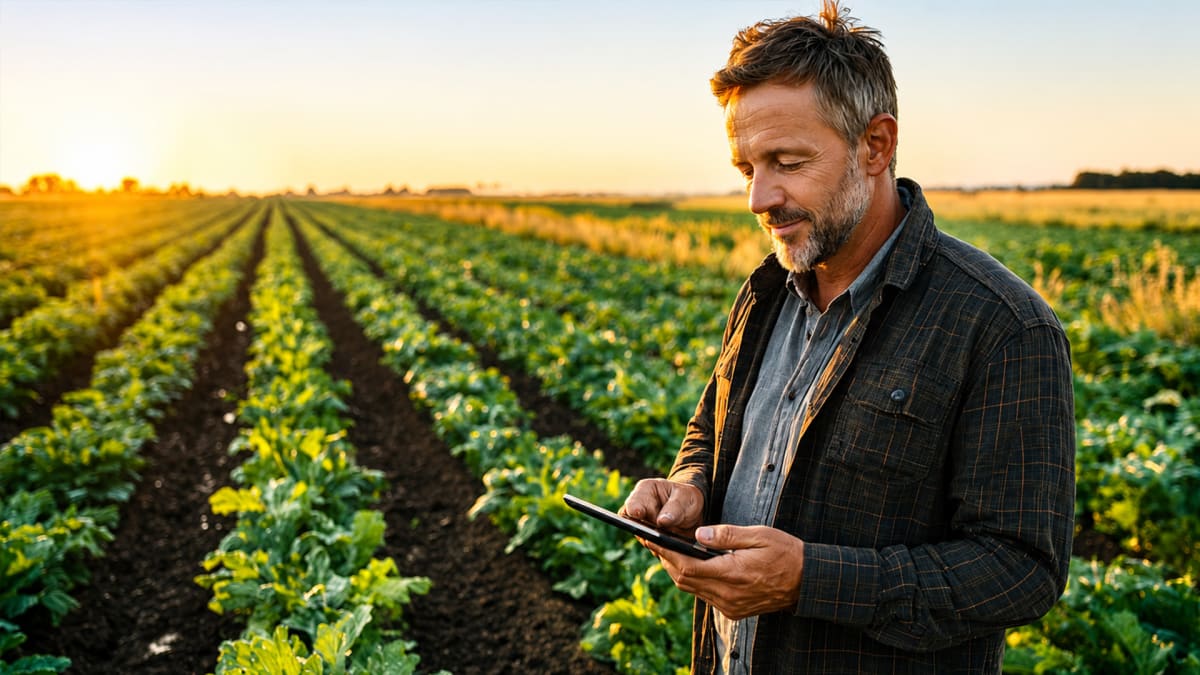
From Dirt to Data
Florida agriculture has always required ingenuity. These days, the toolbox includes artificial intelligence, automated equipment, precision sensors, and researchers who know their way around both a citrus grove and a startup pitch.
Across the state, agricultural technology is becoming a larger part of the conversation about Florida’s economy. Often shortened to AgTech, the field brings together growers, scientists, engineers, entrepreneurs, and investors to solve problems that cannot be handled with a sturdy tractor alone. Water must be used carefully. Labor remains difficult to secure. Weather, pests, and shifting growing conditions continue to complicate decisions that were never simple in the first place.
The goal is practical: help farms produce more efficiently while creating businesses, jobs, and technologies that can grow beyond the field where they were first tested.
In Gainesville, the University of Florida Institute of Food and Agricultural Sciences is working to shorten the distance between promising research and a product someone can actually use. The new UF/IFAS Office of Strategic Partnerships & Innovation is designed to connect faculty with companies, investors, private funding, and guidance on intellectual property and business formation.
That matters because a useful discovery can spend years sitting in the laboratory equivalent of a back pasture. Moving it into the marketplace requires testing, licensing, funding, manufacturing, and people who understand how to translate scientific work into a viable company. The office will also help businesses connect with UF/IFAS research resources, develop internships, and build a stronger pipeline of workers familiar with agriculture’s increasingly technical side.
The state has placed additional weight behind that effort. FloridaCommerce’s designation of agricultural technology as a target industry formally recognizes AgTech as an economic-development priority. The move puts agriculture in the same forward-looking conversation as other technology-driven sectors, with attention on investment, workforce preparation, commercialization, and business growth.
For Florida communities, the stakes extend beyond impressive machinery. Precision agriculture can help growers apply water, fertilizer, and crop protection more carefully. Automation may reduce some labor pressure. Artificial intelligence can help make sense of field data quickly enough to guide real decisions.
Florida will always be known for what comes from its soil. Increasingly, its next crop may include software, sensors, startups, and homegrown ideas capable of changing how food is produced.
Explore Florida colleges and specialized training opportunities in the Guide to Florida directory: https://guidetoflorida.com/college-specialized-training.