



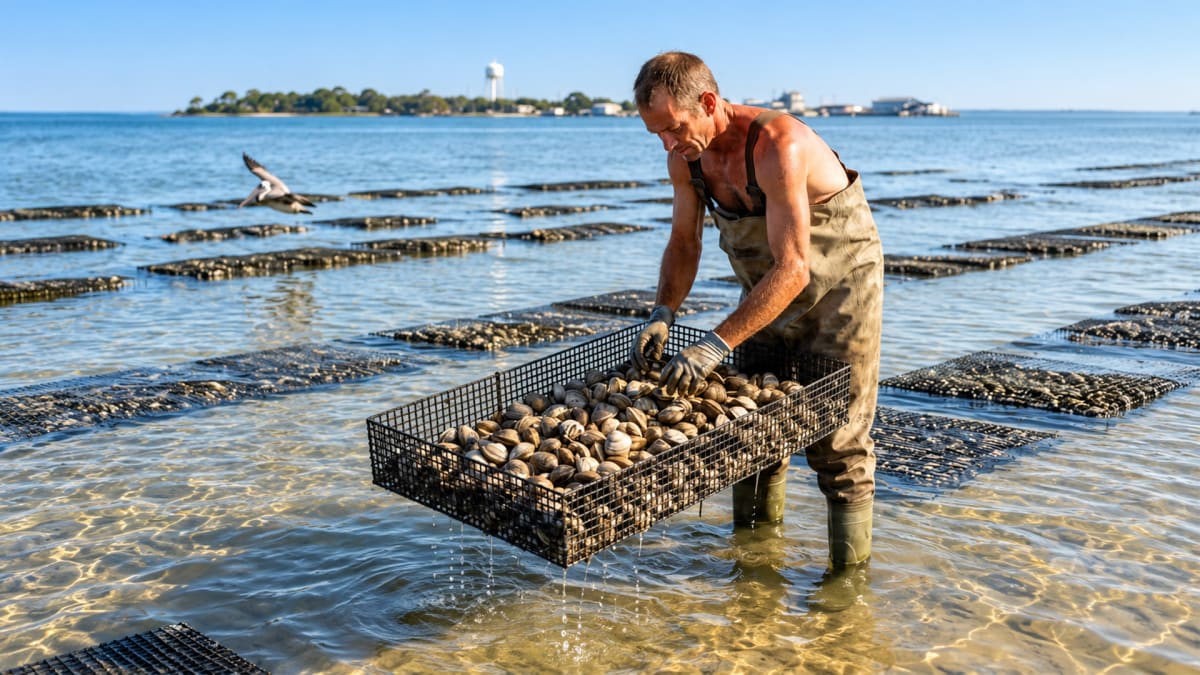
Clams Are Crops. Who Knew?
Clams don’t look much like a cash crop. Neither do tropical fish, oysters, or alligators. But grab a boat instead of a tractor, and the definition of farming gets considerably more interesting.
Under state law, aquaculture is agriculture, putting a surprisingly broad collection of underwater operations in the same general business as more familiar farms. The Florida Department of Agriculture and Consumer Services counts about 1,000 certified aquaculture farms producing more than 1,500 varieties of fish, shellfish, aquatic plants, reptiles, and amphibians.
And these aren’t tiny numbers hiding beneath the surface. According to the Florida Aquaculture Industry Overview, farm-gate sales reached $165.9 million in 2023, more than twice the 2018 total of $71.6 million. That put the state fourth nationally in total aquaculture sales.
Farming Below the Waterline
Shellfish offer perhaps the clearest example of how familiar farming practices translate underwater. Through the state’s shellfish aquaculture program, growers can raise clams and oysters in approved coastal waters. Aquaculturists can lease state-owned submerged lands for production, turning patches of seafloor and water column into working farms.
The crop list gets stranger from there. Aquaculture operations raise food fish, aquatic plants, alligators, turtles, bait, and ornamental species. Florida leads the nation in ornamental fish production, accounting for roughly 45 percent of the U.S. ornamental fish economy.
These operations are farms in more than name. Commercial aquaculture businesses generally need an Aquaculture Certificate of Registration and must follow state best management practices. Certification also gives producers access to agricultural benefits, including certain tax benefits.
Plenty of Water to Grow Into
The industry’s next chapter is already taking shape. FDACS has published a new 2026 Florida Aquaculture Plan focused on research, farm productivity, economic development, technology, and other issues that could help the sector expand.
That matters because aquaculture sits at an unusual intersection of agriculture, coastal economies, food production, recreation, and conservation. A farm might produce dinner, aquarium fish, aquatic plants, or species used in restoration work.
So the next time someone mentions farm country, don’t automatically picture fence posts and hay bales. Some crops are planted beneath nets, tended from boats, and harvested with saltwater dripping off them.
Dive into more of the people, places, and pursuits connected to the water at https://guidetoflorida.com/sports-recreation!